
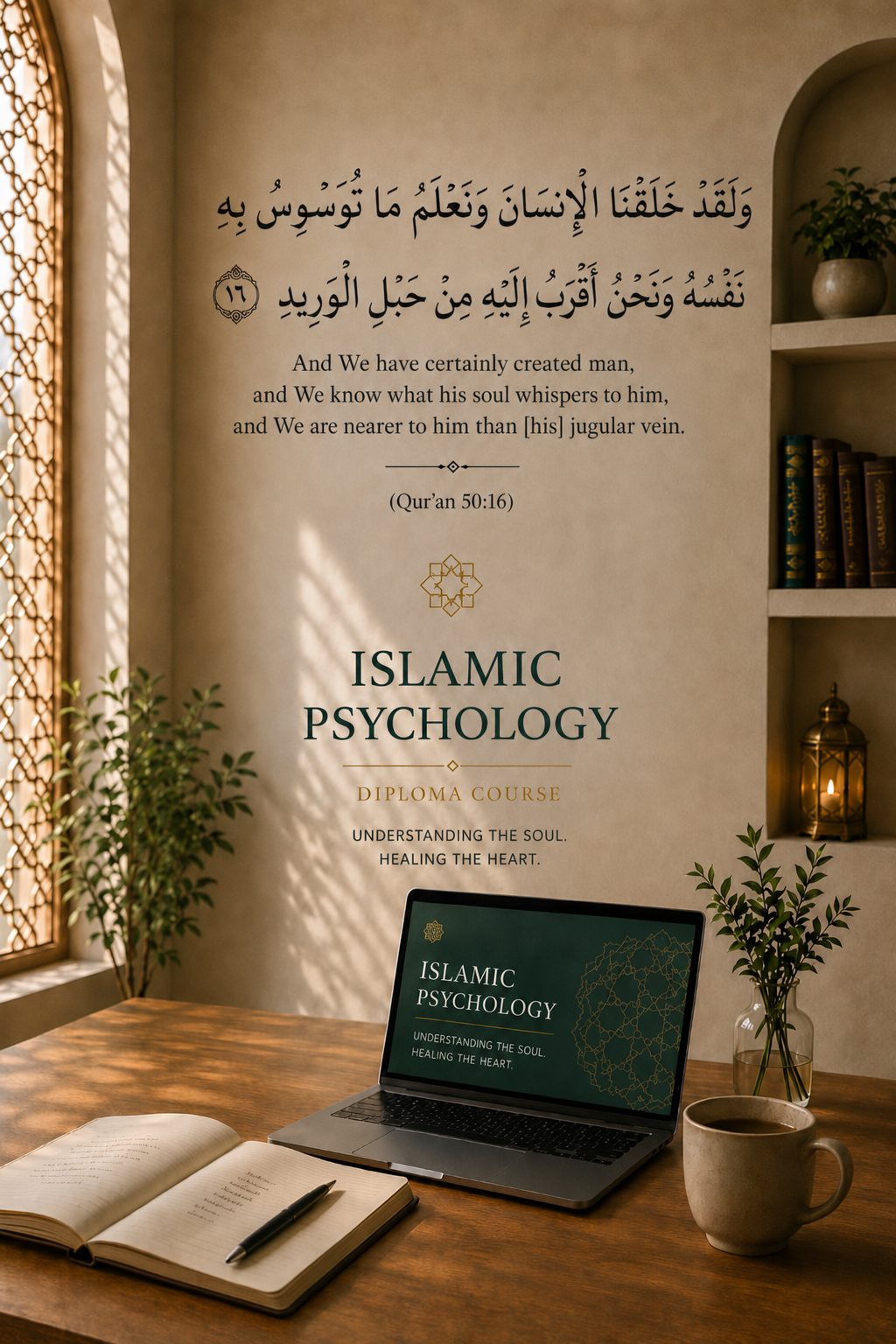
Introducing BT Academy’s Diploma in Islamic Psychology
The Islamic tradition's own science of the human being — articulated deeply enough to become transformative. BT Academy’s cutting-edge interdisciplinary DIPLOMA IN ISLAMIC PSYCHOLOGY equips students with a coherent understanding of the inner workings of the human being from the discipline of ʿilm al-nafs. A 26-week diploma in ʿIlm al-Nafs — the anatomy of the human being, the journey of the soul, and the disciplines through which it heals. Taught from inside the tradition, in serious dialogue with Western philosophy and psychology, by Dr. Francesca Bocca-Aldaqre.
INSTRUCTOR: Dr. Francesca Bocca-Aldaqre
DURATION: 26 weeks (Two Terms of 13 weeks)
DELIVERY: Blend of online live lectures and tailored one-on-one tuition
FEES: £2,300 / $2,900 per term
START DATE: September 13, 2026 - Application deadline: September 10th, 2026
Course Structure
Term 1:
Module I: Situating ʿIlm al-Nafs as a Sovereign Discipline
The opening six weeks establish the field. What ʿIlm al-Nafs is — and what it is not. Its epistemology, vocabulary, and 1200-year intellectual history. The institutions within which it operated for a thousand years. The contemporary moment, what has been lost, and what the discipline answers from its own resources.
Term 2:
Module III: Spiritual Physiology
The journey itself. From ghafla — the heedlessness of the contemporary moment — through yaqẓa, tawba, the disciplines of nafs, qalb, body, and rūḥ, to iḥsān as destination. Each stage taught for the seeker who will live it, not for the clinician who will manage it from outside.
Module II: The Anatomy of the Human Being
The structural anatomy: nafs, qalb, the two eyes of the heart, rūḥ, body, fiṭra, akhlāq. How they relate, what each one is and is not, and why the contemporary stack-model of the human being misses the integration the classical tradition holds.
Module IV: The Therapeutic Umma
The closing module. Himma as the energy that sustains the work. The optimism of the believer. The student's vocation in their existing role. The final essay as an extended muḥāsaba.
Meet your instructor
Dr. Francesca Bocca-Aldaqre is a neuroscientist, a student of theology, and a teacher of ʿIlm al-Nafs. She holds a Master's degree in Neuro-Cognitive Psychology and a PhD in Systemic Neuroscience from the University of Munich, and a Diploma in Islamic Psychology from Cambridge Muslim College. Her work bridges classical Islamic intellectual sources and contemporary clinical-scientific practice. She is the author of "The Italian Islam Manifesto" and the forthcoming Handbook of Islamic Psychology, which serves as the textbook for this course.
For more information and contact details, please check out the following link:

Frequently Asked Questions
Is it a beginner-friendly program?
Yes. The diploma assumes no prior background in Islamic Sciences or in Western psychology. Because ʿIlm al-Nafs operates from its own categories and vocabulary, prior fluency in either field is not required to follow the course — though it will, of course, deepen what the student is able to do with the material.
Will there be a certificate?
Yes. Upon successful completion of the program and its requirements — including the final written work — students receive the official Diploma in Islamic Psychology from Blogging Theology Academy.
How much time will the course require each week?
Two hours of live teaching, plus expected reading and reflection of three to four hours per week. Students are also expected to attend individual office hours periodically throughout each term.
What happens if I miss a session?
All sessions are recorded and made available to registered students within 24 hours. Live attendance is strongly preferred and structurally important to the cohort experience, but occasional absences can be made up through the recordings. Sustained absence may compromise the diploma.
Is this clinical training?
No. The diploma is a serious intellectual and spiritual formation in ʿIlm al-Nafs, not a clinical credential. Students emerge with the framework to read themselves and others through the tradition's own categories, and to participate in a therapeutic Umma — but not as licensed clinicians.
Is this course only for Muslims?
No. The course is taught from inside the Islamic tradition, with all its sources, vocabulary, and presuppositions intact. Non-Muslim students who want to engage the tradition on its own terms are welcome and have completed the course in past cohorts. The framework is taught as universal — addressing the human being as such — and the tradition itself, in the language of the Qurʾān, names the Prophet's mission as raḥmatan li-l-ʿālamīn, a mercy to all the worlds.
What can I do with the diploma afterwards?
The diploma is not a clinical credential but a formation. Students from past cohorts have brought it into their professional roles in mental health, education, chaplaincy, community leadership, and academic research; others have used it for sustained personal and spiritual work. The diploma marks rigorous training and a serious commitment to both classical and contemporary perspectives on the human being.
This is for you if...
You sense that the Western default for understanding the soul, the mind, and human flourishing is not adequate to what you have actually lived.
You are intellectually serious. You want to be challenged. You want a course that respects what you already know and takes you somewhere you cannot reach alone.
You are willing to do the work — readings, weekly sessions, sustained engagement with primary sources — over two terms.
You want to bring what you learn into your own life and into the lives of those around you. You believe healing is real, and that a community can carry it.
You are a therapist who is interested in discovering clinical frameworks which are derived from the Islamic tradition.
This is not for you if...
You are looking for a quick certification, a credentialing pathway into clinical practice, or a self-help framework.
You want a survey course that treats the Islamic tradition as one option among several equally valid worldviews.
You cannot commit to weekly attendance and substantial reading across two terms.
You believe materialistic descriptions of human behaviour are sufficient
Tuition Fees:
£2,300 / $2,900 per term
Scholarships: A limited number of full/partial scholarships are available, being awarded on merit. An interview is required before granting a full scholarship. Candidates will be invited after submitting a formal application.
What is included:
Twenty-six live teaching sessions across two terms
Individual office hours with the instructor
Digital access to the forthcoming Handbook of Islamic Psychology.
Curated weekly reading lists (classical primary sources and contemporary scholarship).
Full session recordings for registered students.
Official Diploma in Islamic Psychology from Blogging Theology Academy upon completion.
Classes take place on Sundays at 4 pm UK time.
Scholarships are limited, and candidates must sit for an interview as part of the selection process. There is no separate application; simply indicate whether you are requesting a partial or full scholarship in your personal statement. The deadline to apply for the scholarship is August 13th, 2026.
Islamic Therapy for Spiritual Trauma
See Dr. Francesca’s interviews with BT Academy Founder and Director Paul Williams
Student Testimonials
"Amazing mashallah — I never knew how much wellness and mental health issues had been addressed in the previous generations."
— Atiya, 2026 cohort.Ameer Zoabi
“I am truly thankful to have discovered this course, as it has placed me among paradigms and philosophical perspectives shared by like-minded peers—a much-needed contrast to the materialist ideologies which are predominant among many of my university professors.”
Motaz Malla
On a personal level, reflecting on the concepts of Islamic Psychology has created a clear “before and after” in my understanding of life and faith. It has shown me how this discipline completes our deen by providing a framework to understand the Nafs, the heart, and the soul within the reality of the dunya test. It is not merely intellectual knowledge, but a guide to living with balance, awareness, and closeness to Allah.
“Ask us a question”